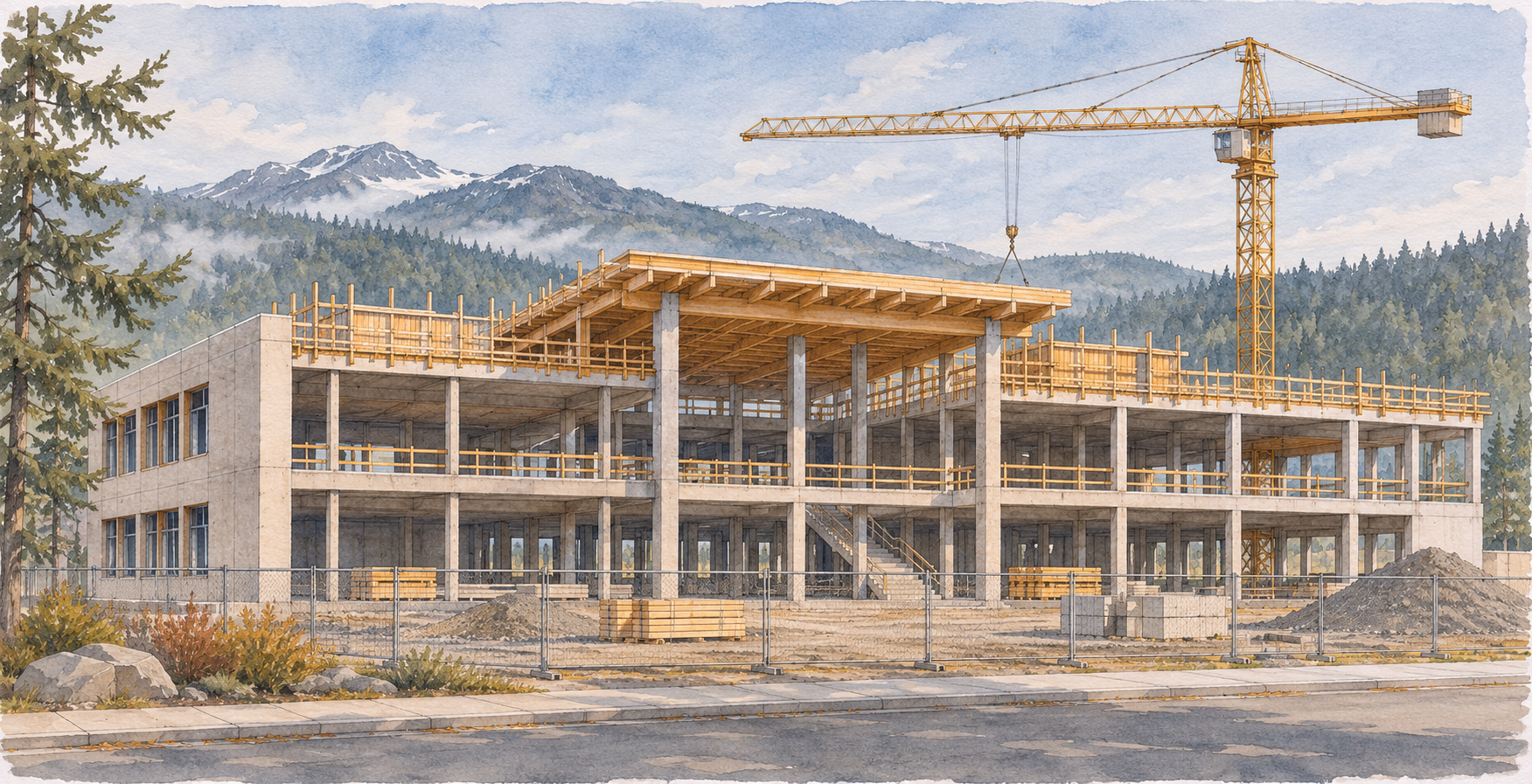
Three times, Alcuin College told judges that construction of its new North Vancouver campus was about to stop unless a notice of litigation came off the land title. Three times, the notice stayed and work continued. On the school’s fourth application, Justice V. Jackson found that its latest warning still depended on a chain of decisions others might never make. The B.C. Supreme Court dismissed the application.
The notice protects a claim to a particular part of the building. In Montaigne Group Ltd. v St. Alcuin College for the Liberal Arts Society, the judge also allowed the school to expand its construction claims and refused requests to postpone the joint trial. The October 23 ruling settled what the parties could argue and on what timetable. Who breached the construction agreement, and who was entitled to the disputed space, remained for trial.
Why the fourth floor mattered
Under a 2020 joint venture agreement, Montaigne was to build a three-storey independent school with a fourth floor that would become a separate strata lot for Montaigne. Vancity advanced construction funds according to the percentage of work completed. Concost Consultants monitored the work for the lender so that advances would reflect the value actually in place.
After delays, Alcuin terminated the agreement in April 2023. Montaigne sued to compel the school to take the steps needed to create the fourth-floor lot. It registered a certificate of pending litigation against the land, putting anyone dealing with the campus on notice of that claim. Alcuin counterclaimed over alleged deficiencies, including concrete that it said needed substantial repairs. It later sued both companies, alleging that progress reports overstated the work and led to excessive payments. Both companies denied the allegations.
Why the notice stayed on title
To have the certificate cancelled for hardship, the school had to show that the registration caused, or was likely to cause, hardship of real significance. Jackson accepted that keeping the notice on title disadvantaged the school. The evidence fell short of showing that the disadvantage met the legal threshold for cancellation.
Construction was still underway at the hearing. Jackson found that Alcuin had overstated the risk to its construction insurance and the fragility of its loan. Insurance premiums and property taxes would have been payable anyway. Nor did the evidence show that the notice prevented the City of North Vancouver from considering the school’s application to divide the property into strata lots. Counsel for the school acknowledged that registration of the subdivision was a separate step handled by the Land Titles Office.
Even if Alcuin had proved hardship, Jackson would still have refused to lift the notice. Assembly space was rare in North Vancouver, raising a question about whether money could adequately compensate Montaigne if it proved its right to the fourth floor. Alcuin had also offered no undertaking to pay damages. A material change in circumstances could justify reconsideration, but Jackson cautioned that another application could itself derail the trial.
Which construction claims could proceed
The judge allowed amendments to both the school’s counterclaim and its separate lawsuit. Montaigne argued that it faced new claims close to trial and might have lost the opportunity to seek contributions from others. But the original counterclaim already sought the cost of completing construction above the $6.8 million contract price, including repairs. That gave Montaigne notice that the condition of the work and the cost of fixing it were in dispute. Document production and questioning of witnesses were still open, and the judge found it unclear that the time for Montaigne to bring in third parties had expired.
In the separate lawsuit, some amendments did introduce new claims against Montaigne, including negligence, negligent misrepresentation and breach of fiduciary duty. Jackson assumed for the purpose of deciding the motion that a limitation period might have expired. Even on that assumption, the new claims concerned the same project, parties and disputed requests for payment. The judge allowed the amendments against Montaigne without conditions. Concost consented on different terms. It could still argue at trial that claims against it were out of time, and Alcuin would pay its costs of the amendment application regardless of the trial result.
Why the judge kept the joint trial date
Montaigne and Concost sought more time to prepare. Concost also proposed separate trials. They had been preparing for a joint hearing for more than a year, and the overlap in the evidence meant separate trials would duplicate work. Expert-report deadlines had already been extended. Neither company gave the judge enough detail about which experts it still needed or why they could not report in time.
Montaigne itself owed outstanding documents, including communications about delays that were already at issue. Both companies had chosen to wait before questioning witnesses. Against their concerns about preparation, Jackson weighed the effect of a postponement on Alcuin, whose land would remain subject to the notice for longer, and on other litigants. The court had reserved 20 days for these actions starting January 11, 2027. With three months remaining at the time of the ruling, Jackson found that a fair trial was still possible.
The order gave the parties two weeks to agree to an adjournment and required them to notify the court immediately if they did. If they agreed and the earliest available replacement dates were in Abbotsford, the joint trial would take place there. Apart from the costs specifically awarded to Concost, the judge left the costs of the applications to follow the outcome of the litigation.